
Price every jar of jam, sauce and preserves for profit
Jams, jellies, hot sauces, salsas, pickles or chutneys: see what each jar really costs to make, what to charge for it at the market, and which products earn you the most. Built for small batch makers and cottage food sellers.
No sign-up. Works in your browser. Your recipes stay on your device.

Small batch makers often charge too little
It is easy to price a jar by what the stand next to you charges. The problem is that the real cost of a jar hides in places you do not see at a glance.
Fruit and produce change with the season
Strawberries in June and strawberries in January are two different prices. A price you set at the start of the season may barely cover your costs at the end of it.
The jar can cost as much as what is in it
Glass jars, lids, bottles, labels and fabric toppers are a big share of a small jar, and they are the first thing left out of the price.
Not everything you buy goes in the jar
Pits, stems, peels and cores go in the bin, and a long simmer cooks the batch down. If you cost the fruit you bought, not the fruit you used, every jar looks cheaper than it is.
How to price a jar of jam or sauce
A simple method many small food businesses use is food cost percentage: the share of the selling price that goes to ingredients and packaging.
Find the cost per jar
Add up what the ingredients you used cost (only the part of each package that went in), plus jars, lids and labels. Divide by the number of jars the batch fills.
Pick a target food cost
A common starting point is a food cost between 25% and 35% of the price, which leaves a 65% to 75% gross margin for your time, market fees and profit.
Divide to get the price
Price = cost per jar ÷ target food cost. Then check it against your market and adjust.
A batch of 8 jars of strawberry jam
Strawberries, sugar, lemon and pectin, plus 8 half-pint jars with lids and 8 labels, add up to about $26.00 for the batch, so each jar costs about $3.25 to make.
- Cost per jar
- $3.25
- Target food cost
- 30%
- Suggested price
- $3.25 ÷ 0.30 = $10.83
Selling them at $12 instead brings your food cost down to about 27%, a 73% gross margin. PanProfit shows all of this for every recipe, automatically.
Made for the way small batch makers work

Costed by the jar
Set the batch size to the number of jars or bottles it fills, and every cost and price is per jar.
Only what goes in counts
A usable percentage for each ingredient covers pits, stems, peels and hulls, so the cost follows the fruit you actually used.
Jars and labels included
Add jars, lids and labels as packaging, counted by the unit: they show in their own block of every recipe, and are part of every cost and of the shopping list. Your time goes in each batch at your own hourly rate, and market fees go in as separate cost lines.
Spot the products that are not paying off
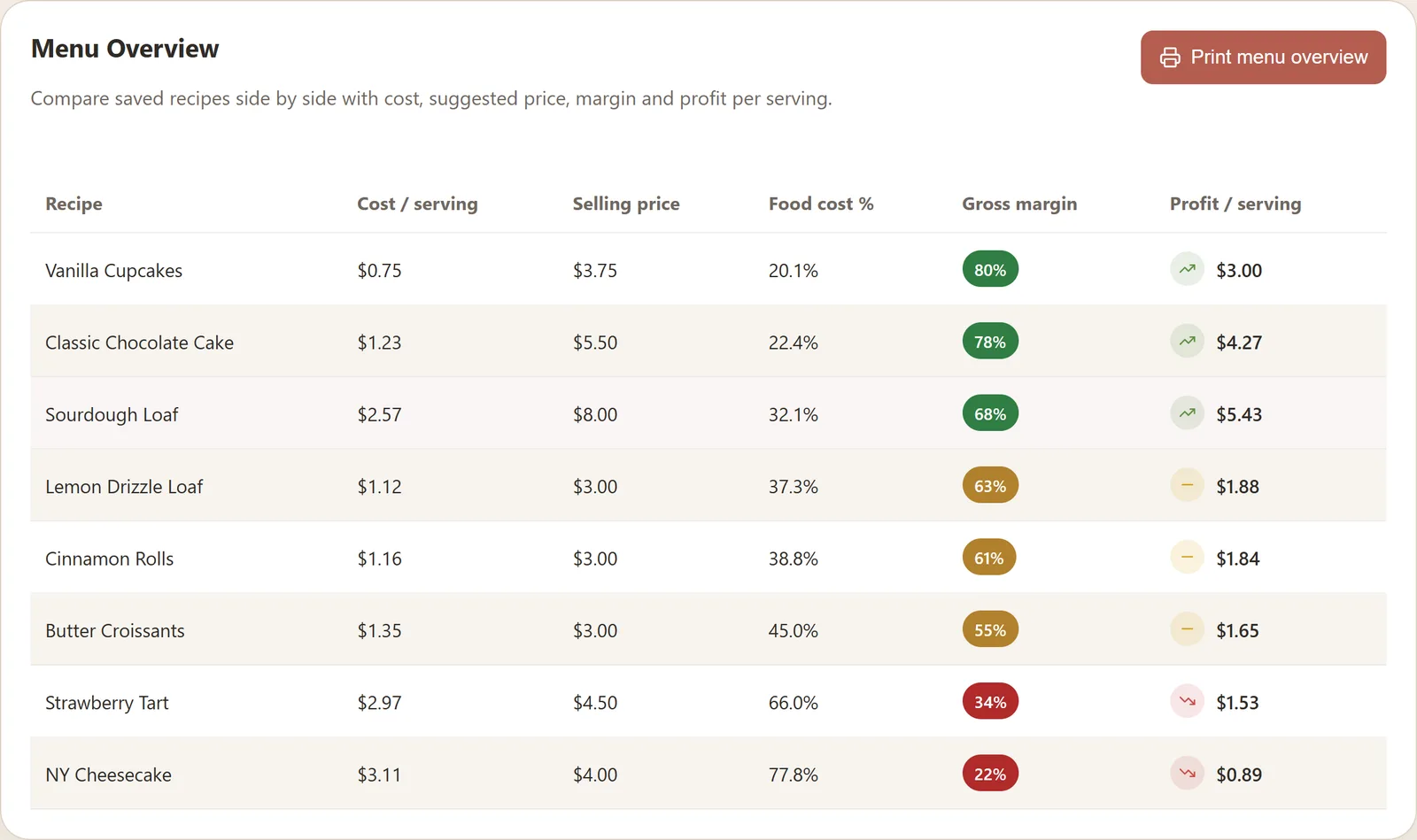
All your products in one table, colored by margin: green for healthy margins, yellow for tight ones, red for items that need a new price or a new recipe.
Sugar went up again? Update its price once: every recipe that uses it changes, and PanProfit shows which products lost margin. With Pro, it also gives you the price that keeps it, and the price history of every ingredient.
Planning a big canning day or a market weekend? The shopping list adds up everything you need to buy across recipes and batches, grouped by store.
Questions from small batch makers
How much should I charge for a jar of homemade jam?
It depends on what the jar costs you. Add up the fruit, sugar and pectin you used, plus the jar, lid and label, and divide by your target food cost (25% to 35% is a common range). Then compare with what similar jars sell for at your market. PanProfit does the math for every recipe.
Can I include jars, lids and labels in the cost?
Yes. Add them as packaging, counted by the unit (for example a pack of 12 jars), and use one of each per jar in the Packaging block of the recipe. They are then part of the cost per jar and show up in the shopping list.
What about the fruit I cut away?
Each ingredient line has a usable percentage. If you lose about 15% of your strawberries to hulls and bruised spots, set it to 85% and the cost follows the fruit that actually went in the pot.
I sell under cottage food rules. Can I use PanProfit?
Yes. Cottage food rules (which products are allowed, labels, permits, sales limits) vary by state, and many states treat low-acid or refrigerated sauces and pickles differently from jams, so check your state's requirements. PanProfit helps with costs and prices, not with legal compliance.
Is it really free?
Yes, for up to 10 recipes, with unlimited ingredients and no sign-up. When your product line grows, PanProfit Pro (USD 19.99 a year) gives you unlimited recipes and the price that keeps your margin. Your recipes are saved in your own browser on every plan, and you can back them up to a file anytime. See Pricing.
Know what every jar earns you
Add your best seller first. It takes a few minutes, and you may be surprised by what it really earns.
Open the app, it's free